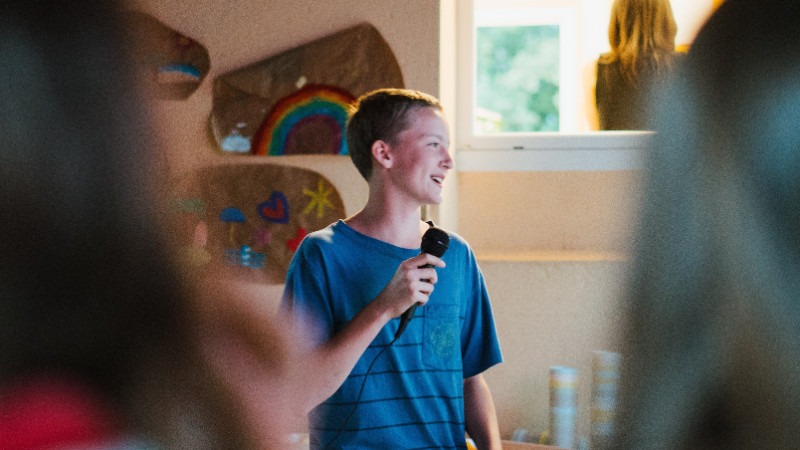
Do traditional language classes still have a future in the age of artificial intelligence?
In short: ChatGPT translates in a second, corrects grammar without complaining, and never sleeps. So why keep sending your child to learn German or English at language camp instead of just installing an app? Because a language isn't just about understanding words, it's about making friends, playing a board game without looking at your phone, and existing in a group. AI is an excellent training tool, studies confirm it, but it doesn't replace either the motivation that comes from a good teacher, or the experience of living two weeks with children from around the world. The future isn't one or the other, it's both, but not in the proportions we imagine.
Two summers ago, during a ping pong tournament at Braunwald, I watched a child pull out his phone in the middle of a rally to try to understand what his opponent had just shouted at him in German. Result: the ball went flying, everyone laughed, and the kid ended up learning the word "Aufschlag" (serve) without any app at all, just by repeating it ten times with his friends until it stuck. It's a simple anecdote, but it pretty much sums up why I've been asking myself this question for the past few months: what's the point of learning a language the traditional way, with a teacher, a group, exercises, when artificial intelligence can translate any sentence in the blink of an eye?
Is it still useful to learn a language, seriously?
Very honestly, yes, and it's not even debatable. But what's interesting is understanding why, because the usual argument ("it's useful for traveling, for work") completely misses the point.
In a camp, you notice it within hours. A child participating in a painting workshop or playing a board game like Dixit with their phone in hand to translate everything is a child missing half the experience. They're looking at their screen instead of looking at the cards, they're translating a joke instead of laughing at the right moment, and most importantly, they're putting a barrier between themselves and the rest of the group. Language here isn't a school exercise, it's the necessary passage to socialize. And a child who can't say to their roommate "pass me your pillow" without pulling out their phone is a child who stays a bit on the sidelines of the group, even if everyone makes an effort to include them.
This is even more true in Switzerland. We live in a country where multilingualism isn't a cultural detail, it's written into the Constitution: four national languages, and a school system that requires every student to learn at least a second national language in addition to English. The Federal Statistical Office regularly reminds us that language skills aren't just for traveling, they're a pillar of cohesion between regions of the country and real capital for the Swiss job market. A French-speaking child who doesn't speak a word of German, or a small German speaker who doesn't understand French, isn't just "too bad," it's a door that remains closed to a good part of their own country.
So yes, learning a language remains essential. What changes, however, is the way you can learn it. And that's where the question of AI becomes interesting.

Is AI a better teacher than a flesh-and-blood teacher?
Well, the honest answer is yes and no. And I think it's important to say that clearly, because we tend to either demonize AI or believe it's going to replace teachers within two years. Reality is more nuanced, and rather encouraging.
What AI really does well. A recent meta-analysis covering around thirty studies measured a significant effect of chatbots on second language learning, with a particularly pronounced impact when it comes to generative AI rather than older rule-based conversational robots.
Concretely, an AI is available at 3 a.m., it never gets annoyed at being asked the same question ten times, and it can adapt every exercise to the student's exact level in real time. A study published in early 2026 even showed a result that surprised me: among students who took an oral exam with an AI rather than with a human examiner, anxiety related to public speaking had almost no impact on their results, while it had a very marked impact with a flesh-and-blood examiner. For a shy child who freezes at the idea of making a mistake in front of an adult, that can clearly help them get started.
What AI doesn't do, and won't do anytime soon. An AI can't organize a hike to the village to interview residents in German, with butterflies in your stomach and pride right afterward when you managed to make yourself understood. Nor can it sit around a table to play Dixit with a group of six children, sense that one of them is getting bored, and restart the game with a joke. And that's far from insignificant. A study comparing feedback given by ChatGPT and feedback given by teachers showed that students receiving human support progressed more, notably because the trust they placed in their teacher, nourished by a real emotional bond, played a decisive role in their motivation.
In other words, it's not so much the quality of the correction that matters, it's the fact that a human believes in you and shows it to you.
At friLingue, that's not actually why our teachers are there. Correcting an accent or a grammar mistake, an app can do that very well, and sometimes better than we can. We're there to motivate, to make things fun, to turn a vocabulary lesson into a treasure hunt in the forest. An AI can give you a list of words to learn. It can't give you the adrenaline rush of having to improvise a sentence in front of a real Swiss saleswoman who doesn't necessarily have the time or patience to wait for you to find your words.
The price, yes, but not just the price
Let's be clear on one point: an AI will always cost much less than a language camp in Switzerland. It's a fact, and we're not going to pretend otherwise.
For twenty francs a month, you can have access to a tutor available all the time, and for some families, it's a real option, especially for regular training between stays.
But what a subscription doesn't sell is waking up one morning knowing you're going to see your five roommates who come from Spain, Germany, and South Korea. It also doesn't sell the smell of acrylic paint from a creative workshop on a rainy afternoon, an improvised soccer game where you're negotiating the rules in three languages at the same time, or a campfire evening where you learn a traditional song you didn't know the day before. An AI doesn't cry at the moment of goodbyes on the last day, nor does it receive a message the following year from a former student saying they got back in touch with their Brazilian camp friend on Instagram.
So does AI replace traditional language classes?
No, but it makes them smarter. I genuinely believe we're heading toward a world where AI manages the mechanical part of learning very well—vocabulary, repetition, basic grammar—while humans focus on what they do best: inspiring, creating connections, and creating those small moments of useful vulnerability where you dare to speak a language you don't yet master, in front of real people, in a real context.
FAQ
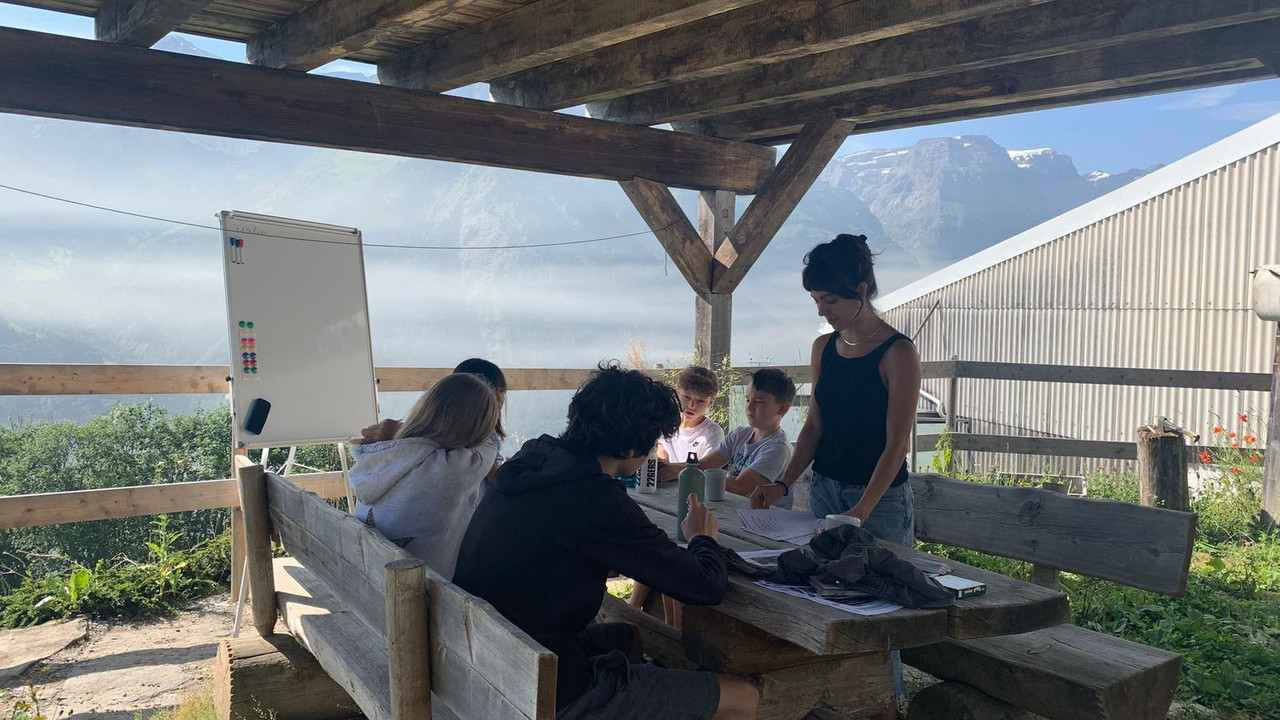
Does friLingue use AI in its classes? No, classes are taught by teachers, in small groups of six, with a central place left for speaking and activities, but teachers sometimes explain to those who wish how to use AI intelligently to practice alone when they return from camp.
If a child is afraid to speak because of their accent, can that really improve in two weeks? Yes, and often faster than you might think. The welcoming environment of the group, combined with the absence of grading, removes most blocks within a few days.
Do you have to choose between learning apps and language camp? No, the two complement each other very well. Many of our participants use an app between stays to maintain their level, then come to camp to practice in real conditions.
